 Super
SuperRoofing in Piney Flats, Tennessee
Twenty minutes south of us on 11E, between Bluff City and the Washington County line. Rocky Mount, Boone Lake, big wooded lots, and the roof problems that come with all three.
Piney Flats is unincorporated Sullivan County, strung along US-11E on the run down toward Johnson City. Rocky Mount — the 1770s house that served as the territorial capitol — sits on the highway here, which tells you how long people have been putting roofs on buildings in this spot. Boone Lake is off to the west, the Watauga comes in below, and TN-75 cuts across toward the airport.
Storm damage, and what we can and cannot do about your claim
Hail peaks in May here and the damaging straight-line wind arrives in June, with a second run at it in November. On a wooded lot the wind is only half the problem — the other half is what the wind puts on the roof, and a limb through the shingles in a winter storm is the most common emergency call we get out this way.
What we do after a storm: get on the roof, photograph what is actually up there, and hand you a written report with the damage marked and dated. That report is yours. You give it to your insurer, or to a licensed public adjuster if you decide to hire one. Then we do the repair or the replacement.
What we will not do, and be wary of any roofer who offers to: contact your carrier to argue the scope, tell you what your policy covers, meet the adjuster as your representative, or promise you an outcome. Negotiating a claim on your behalf is public adjusting — a licensed profession in Tennessee — and a roofing contractor doing it is doing someone else's job. Your deductible is yours to pay, too. Anyone offering to waive it, absorb it, or discount their invoice to cover it is describing insurance fraud, and it is your name on the claim.
Piney Flats is about twenty minutes from the shop and we work along 11E constantly. We are a Bristol company, A-rated and BBB accredited since February 2025. That is a fact about the map and a matter of record, which is all we are claiming.
The lots are the whole story here
What actually shapes roofs in Piney Flats is not the architecture, it is the land. The lots are big, they are wooded, and a great many of them have mature hardwoods leaning over the house. Everything follows from that:
- Constant leaf load in the gutters and, worse, in the valleys. Debris in a valley holds water against the shingle instead of letting it run, and that is where a roof under trees fails first. On a lot like this, gutter guards stop being an upsell and start being maintenance you no longer do twice a year — but the valleys still want clearing.
- Damp shade on the north slopes. A pitch that never gets sun does not dry between wettings, and you get the black algae streaking and the moss that lifts the bottom edge of a shingle course. It is a moisture problem rather than dirt, which is why pressure-washing it makes it worse by stripping granules.
- Limbs. A branch resting on a roof abrades the shingle surface every time the wind moves it, and a branch coming down in a winter storm is the single most common emergency call from a wooded lot.
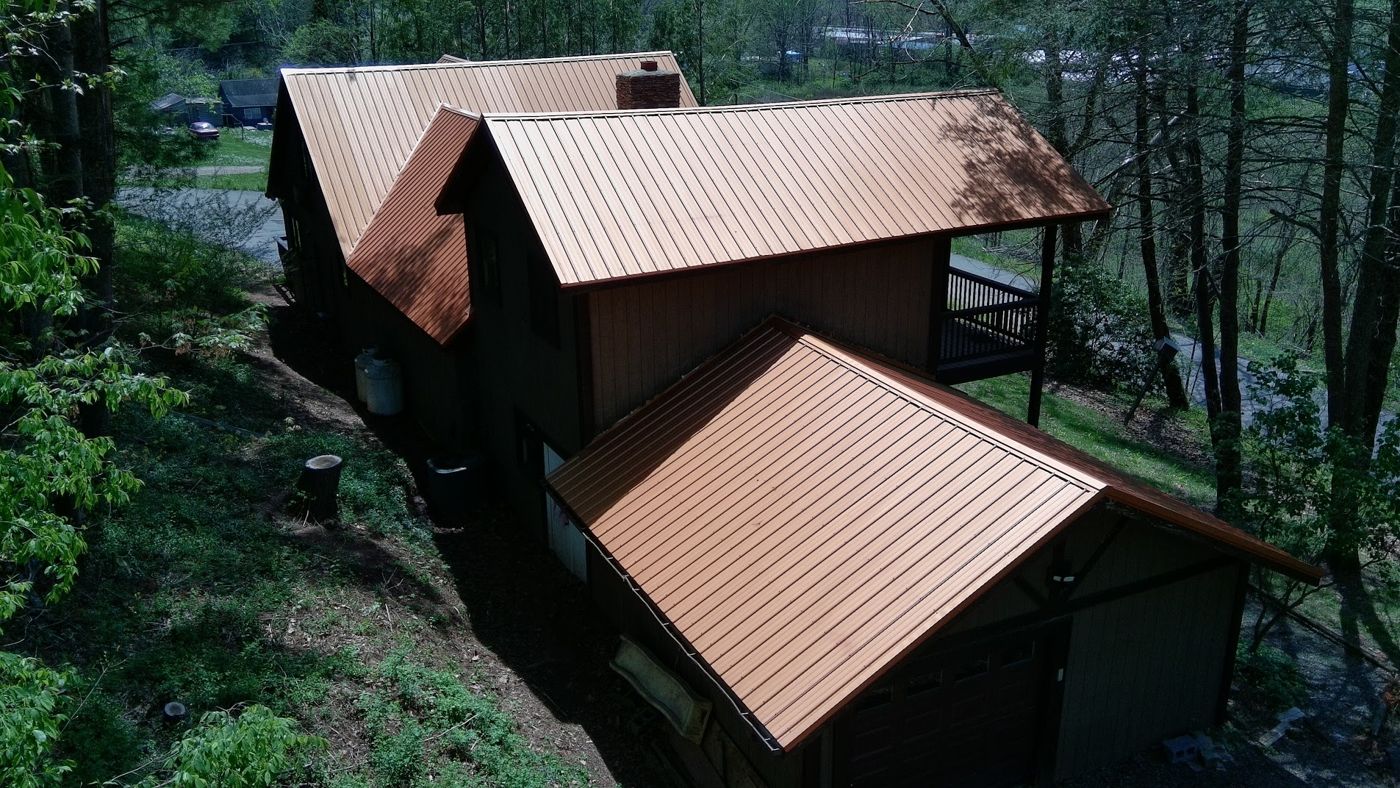
The other thing about rural lots out here is that most of them have more than one roof. Barns, shops, equipment sheds and pole buildings are part of the property, and exposed-fastener metal panel does an honest, economical job on all of them. Standing seam is what we would put on the house. Our standing seam versus exposed fastener comparison sets out why the answer is genuinely different for the two.
Winter, and one thing about the ridges
A roof here freezes and thaws again on most winter nights — around ninety of them a year. Water works into a small gap, freezes, opens it a little wider, then does the same thing the next night. A wet, shaded roof carries more water into every one of those, which is exactly why the shaded lots out here wear out faster than the open ones.
Winter wind is worth knowing about if your house sits high and open. Mountain-wave high winds occur along the western foothills between November and March, and Holston Mountain is among the named sites that report advisory-level winds in those events. That is the wind that finds a lifted rake edge or a ridge cap that was fastened carelessly — not the wind that takes a well-installed roof off.
Getting here
Straight down US-11E from Bristol, about twenty minutes, with Bluff City between us and you and Johnson City fifteen minutes further on. TN-75 runs west toward the airport. Every town we cover is listed here.
Every roofing service we offer in Piney Flats
Whatever your roof needs, it is the same crew and the same phone number. These pages explain how we do each one:
- Roof Replacement — Full tear-off and a complete new roof system
- Roof Repair — Leaks, flashing, valleys and blown-off shingles
- Metal Roofing — Standing seam and exposed-fastener panels
- Shingle Roofing — Architectural asphalt shingles
- Storm & Hail Damage — Documentation and insurance claim help
- Roof Inspection — Free, honest assessment with photos
- Emergency Roofing — Tarping and same-day leak stops
- Gutters — Seamless gutters, guards and downspouts
- Commercial & Flat Roofing — TPO and low-slope systems
Towns next door
Piney Flats sits on the 11E run between our shop and Johnson City. We cover all of it:
- Roofing in Bristol, TN — twenty minutes north on 11E, where our shop is
- Roofing in Bluff City, TN — the next community north, on the Holston
- Roofing in Johnson City, TN — fifteen minutes south, at the far end of the same 11E run
Worth reading before you call anybody
- Are Gutter Guards Worth It? — on a heavily wooded lot the answer is different from the usual one
- Standing Seam vs. Exposed Fastener — the house and the barn want different answers
- Black Streaks and Roof Algae — why the shaded north slope goes first, and what not to do about it
Free Roof Estimate in Piney Flats
Twenty minutes down 11E. We will get on the roof, look at the valleys and the shaded slopes properly, and tell you what it actually needs.